
The Things I Left Behind
On grief, survival, detachment, and the quiet rebuilding of a life after abuse.

Sometimes the hardest part of leaving is not losing the life that hurt you, but losing the life you created to survive it.
The corners of comfort you built quietly and lovingly around yourself. The routines that kept you sane. The objects that witnessed your loneliness. The tiny beautiful things that became emotional lifelines without you even realizing it.
People imagine leaving as one dramatic moment. A slammed door or a final argument. Freedom waiting outside like sunlight after a storm. But leaving is often painfully quiet. It is standing in the middle of a home you once tried so hard to make beautiful and realizing you cannot take most of it with you.
For me, leaving did not happen overnight. It took months of planning, preparing, calculating, waiting for the right moment. Which meant I had time to grieve what I already knew I would eventually leave behind. There was something haunting about continuing to water plants, arrange bookshelves, fold clothes, and cook meals while quietly knowing you would not be taking most of it with you.
Many people escaping abuse do not even get that kind of goodbye. Many leave in the middle of the night with terror in their chest and a few belongings stuffed into trash bags. No time to think. No time to mourn. Just survival. That reality never leaves me, because even with time to prepare, the grief of detachment was immense.
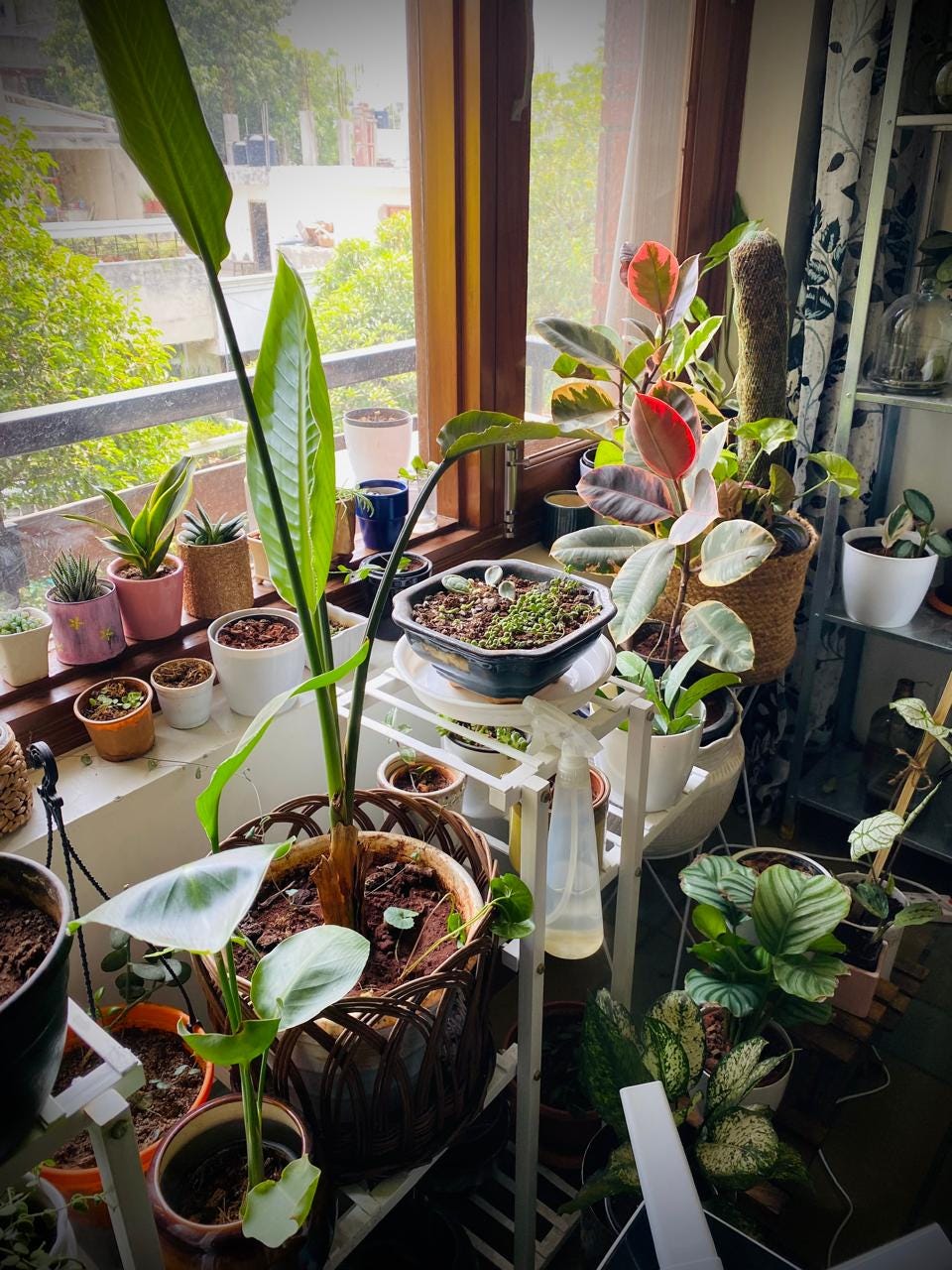
I grieved my plants first.
Every single one had a story. Tiny cuttings I had coaxed back to life. Leaves I celebrated like small miracles. I knew which plant preferred the morning light and which one curled inward when neglected for even a day. In a house where so much felt unsafe and unpredictable, nurturing living things gave me a sense of gentleness I desperately needed. Watching new leaves unfurl reminded me that life still wanted to grow, even in difficult conditions.
I grieved my books.
Books were never decoration to me. They are companions. They held me together on nights I thought I would emotionally collapse. Somehow, the right sentence always finds me exactly when I need it. In those pages, I found language for things I could not explain to anyone else. Wisdom. Escape. Validation. Hope. My books anchored me when reality became too heavy to hold alone.
I grieved my kitchen.
Not the physical kitchen itself, but the life inside it. I had collected far too many tools and equipment over the years, each one chosen with care. Tiny spoons, measuring cups, baking tins, whisks, pans, things most people would call excessive but to me felt like a language I spoke fluently. Every thing had a purpose, a memory, a moment attached to it.
Cooking was never just about food. I cook because I love it, not because I am hungry or someone needs feeding. It was one of the few spaces where I had complete control. Where things made sense. Where effort turned into something tangible, warm, and beautiful. Baking especially felt almost sacred. The precision, the patience, the quiet focus. Watching something rise, transform, and come alive feels like a small act of hope every single time.
In a life that often felt chaotic and unpredictable, my kitchen gave me rhythm. It gave me calm. It gave me a version of myself that still felt whole.
Leaving it behind felt like leaving a part of my daily peace behind.
I grieved my clothes and shoes too.
That may sound superficial to people who have never had to rebuild themselves from scratch, but it wasn’t about vanity. I have always loved fashion because it feels like expression. Every thing had been chosen slowly, lovingly, over years. Certain shoes were small expressions of my whimsy, femininity, personality, and joy. Tiny declarations that beauty and self-expression still mattered, even during the darkest years. They represented someone I was still trying not to lose.
The clothes were never simply fabric hanging in a wardrobe. I had spent years slowly curating them, collecting pieces that reflected who I was, or maybe who I was trying not to lose. And leaving them behind also meant leaving behind my sewing machine, something I deeply loved. I loved creating my own pieces, imagining textures and shapes, turning emotion into something tangible with my own hands. There was something deeply intimate about that process. It was art, identity, and comfort woven together. Leaving it behind felt like abandoning a part of my creative spirit.
And then one day, I walked away with almost nothing.
A bag of comfortable clothes. Important documents. My child.
That was it.
Years of building a life reduced to what I could physically carry.
There is a particular kind of heartbreak in understanding that you cannot save everything. At some point survival asks a brutal question: What matters most? And once you know the answer, everything else becomes secondary.
That realization changed me permanently.
I used to think attachment was love. That preserving things, holding onto memories, protecting every carefully built corner of life was strength. But leaving taught me something else entirely.
It taught me the terrifying and liberating art of detachment.
Not coldness and definitely not indifference.
But discernment.
The ability to understand what is essential and what can be replaced.
Plants can be grown again. Books can be bought again. Kitchens can be rebuilt. Clothes can be curated again. Shoes and bags can be collected again. A home can be recreated.
But peace cannot be sacrificed for possessions. Safety cannot be negotiated for sentimentality. And a child’s wellbeing cannot be traded for familiarity.
There is something deeply spiritual about walking away from almost everything and discovering you still survive. That your soul remains intact even when your life changes form completely. That home was never truly inside those objects, no matter how much comfort they gave you. Home was the part of you that kept loving beauty, softness, learning, creativity, and hope despite living in survival mode.
I think that is what escaping finally gave me. Not just freedom from abuse, but freedom from the illusion that my life existed inside material things.
And none of those things actually left me.
Because in the end, the plants were never just plants.
They were proof that I could nurture life even while slowly breaking inside.
The books were never just books.
They were the voices that held my hand in silence when I felt completely alone.
The kitchen was never just a kitchen.
It was the last place where tenderness still existed naturally within me.
The clothes and shoes were never the point. It was my sense of self-expression.
And none of those things actually left me.
I carried them all out quietly within myself.
I thought I was leaving my life behind.
What I was actually leaving behind was the cage around it.
And maybe that is the strangest thing about loss. Sometimes losing almost everything is what finally allows you to find yourself again.
Today, I understand why people rebuilding after fires still mourn the coffee mug, the garden, the little ordinary things outsiders would dismiss as replaceable. Objects absorb pieces of our lives. They become witnesses to who we were in certain seasons of our existence.
But I also understand something deeper now.
A home can be left behind.
A life can split into a before and after so violently you barely recognize it.
And still, the human spirit quietly begins again.
Slowly. Painfully. Courageously.
Like a new leaf unfurling after winter.
Like hands learning a new kitchen.
Like a woman standing in the ruins of everything she once called home and realizing, with equal parts grief and awe, that while almost everything was left behind, the most important parts of her somehow survived.
I write about surviving and making sense of long-term abuse, the slow process of reclaiming self, and what comes after. This space is grounded in lived experience, not theory. It is as much about clarity as it is about rebuilding. I also write about unserious stuff occasionally.
You can read the first part here: Leaving Was Not a Moment. It Was a Process.